
The huge number of landing craft being built during the Second World War required special hards over which they could be loaded, which most regular ports lacked.
In 1942, in order to support landing craft and amphibious operations against Europe, Lord Louis Mountbatten ordered the construction of special hards around Britain’s south coast.
By 1943, 68 such hards had been built in the South of England.
They were built specifically to load two types of assault vessels: Landing Craft Tank (LCT) and Landing Ship Tank (LST)
The simple design of the Hards comprised a concrete apron above the High Water mark and pre-cast concrete beach-hardening mats in the intertidal area.
This gave a solid surface onto which LCTs and LSTs could “beach”, enabling vehicles to safely drive over and embark into the vessels.
There were thirteen Hards in the Solent.
Six were built at Gosport, four at Southampton and a single Hard was built at Lymington, next to the ferry terminal.

At Lepe, the “Q” hard was built in front of Lepe House (on the Lepe Estate) and the larger “Q2” hard was built at Stanswood Bay (on the Cadland Estate).
The proposed plan for the Q hard constructed in front of Lepe House in 1942.
The approach road and concrete apron (Red) were the responsibility of the War Department, whilst the beach-hardening of the inter-tidal area (Blue) was the responsibility of the Admiralty.
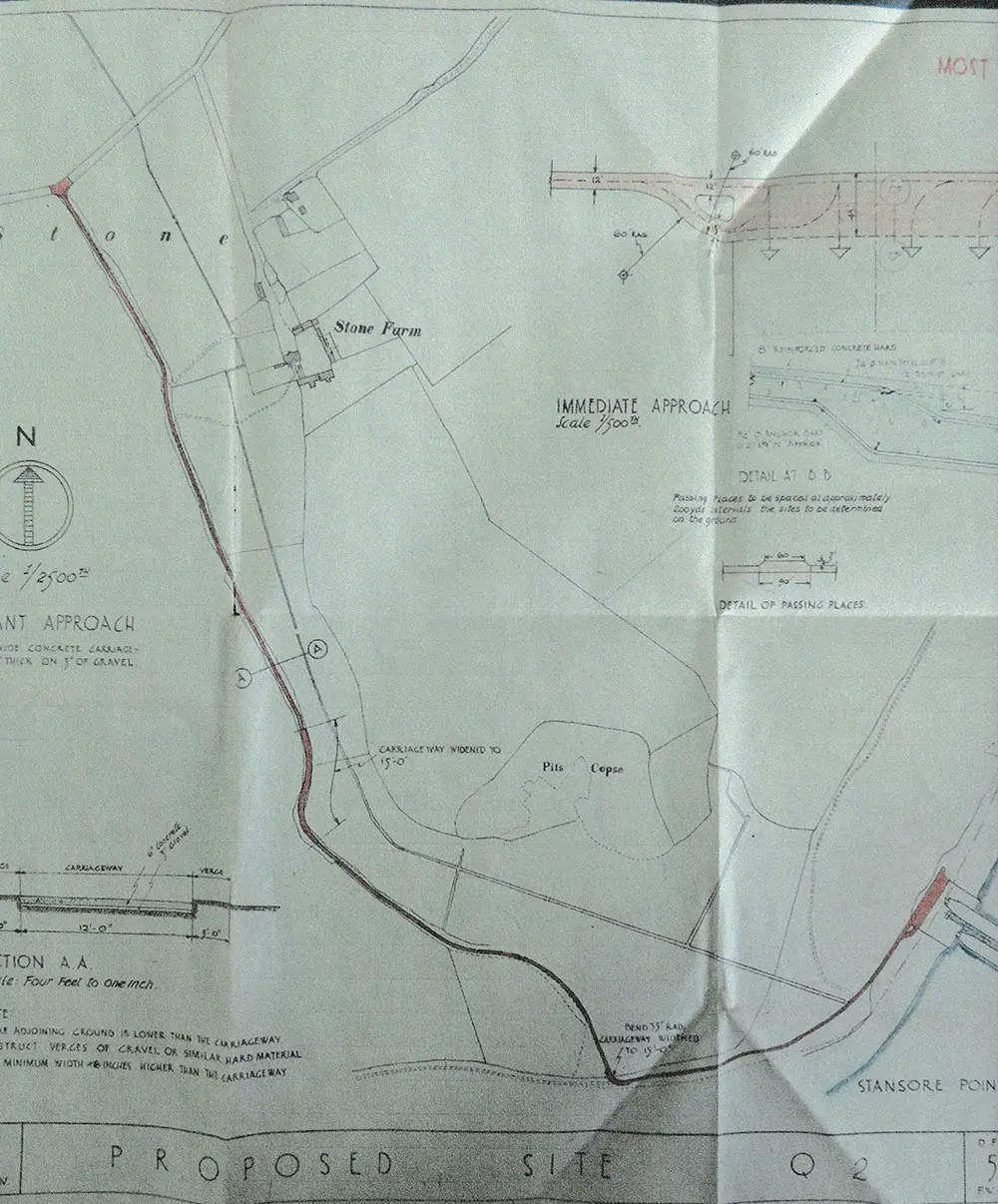
The proposed plan for the Q2 hard approach road and the Hard itself. The long approach road from top LH corner of the drawing is a concreted construction and a junction off Stanswood Road.
The approach road and concrete apron (Red) were the responsibility of the War Department, whilst any beach-hardening of the inter-tidal area (Blue) was the responsibility of the Admiralty
Copyright The National Archives.
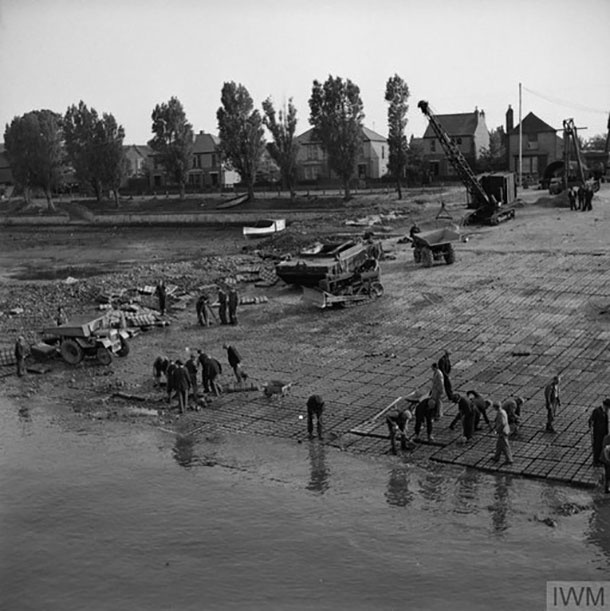
Construction of “GH” Embarkation Hard, at the hardway, Gosport.
In the foreground, pre-cast beach-hardening mats are being laid to provide a solid surface, on which vessels could “beach” and over which vehicles could drive to embark.
In the foreground, pre-cast beach-hardening mats are being laid to provide a solid surface, on which vessels could “beach” and over which vehicles could drive to embark.
In the background a concrete apron is being constructed.
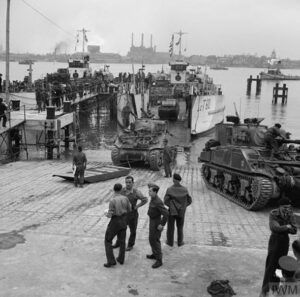
All the Solent hards were used to embark men and vehicles in the build up to D-Day and in the months that followed.
Here, Sherman tanks of the 13th/18th Hussars embark onto landing craft at GF hard in Gosport on 3rd June 1944.
Three days later, they would land on Sword Beach in Normandy.
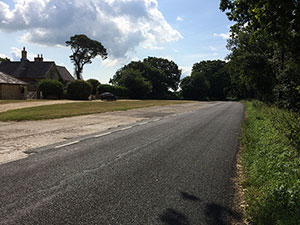
To provide better access to the hards, the roads leading to Lepe were improved.
The waterfront road was resurfaced in concrete and many passing places for columns of military vehicles were built on the Lepe Road between Langley and the coast.
Many of these passing places, such as this example in front of Whitefield Farm are still clearly visible today.
© Stephen Fisher.

The old picture is © IWM (Non-Commercial Licence) Mill Lane Brockenhurst . Pictures showing it “Then and Now” . The road and bridge was strengthened to take heavy army equipment.
