OPERATION OVERLORD was the product of very extensive, complex and highly secret strategic planning meetings, held between the leaders of the Allied Governments of the day.
The meetings that commenced in 1942, culminated in an agreement and commitment between the Allies, to open up a “Second Front” by invading mainland Europe in May 1944.
The Second Front would force the German regime to split its forces engaged in the war with Russia (The Eastern or First Front) and divert troops, equipment and aircraft to defend Western Europe, at a location to be determined.
An attempt to capture a usable port by an unsupported Army , was made in August 1942.
The intention being to become established on mainland France and provide a route through which, reinforcements of troops, equipment, fuel etc could be delivered.
The ill-fated “Dieppe Raid” was, in virtually all respects, a catastrophic failure.
The Allies learned through the sacrifice of armed forces, tanks and equipment that a seaborne attack on an established and strongly guarded, existing port, held by the enemy, could not be successful, without causing such extensive damage to the port facilities to effectively put it beyond use.
(Please refer to the MULBERRY section of this site)
The concept of a Combined Operation Force that brought together the Armies, Navies and Air Forces was conceived.
Each of the Allies would contribute according to its capabilities.
Such a Combined Force was formed with an extremely complex structure and a rigidly operated chain of command.
The chain of command is shown in the REFERENCE MATERIALS section of this site
OPERATION NEPTUNE (within OPERATION OVERLORD) was and remains to this day, the largest seaborne invasion in history, to take place anywhere in the world.
In the period leading up to the actual invasion, the Allies successfully conducted a substantial military deception, Codenamed Operation Bodyguard.
This involved misleading the German high command of the date but primarily the likely location of the main Allied landings.
The weather forecast suggested that wholly unsuitable conditions would prevail for the originally scheduled D-Day, on 5th June 1944.
This caused General Eisenhower to decide that Operation Overlord had to be postponed by 24 hours, to 6th June, when a “more suitable” weather window was forecast to be in place over the UK and Channel
Combined Operations forces carried out cross channel transportation and delivery of tens of thousands of Army personnel with their specialist and conventional equipment onto the Normandy beaches of North West France.
The Combined Operations organisation prepared mine-swept channels for the armada of transportation craft and provided the landing forces with protection from attack by enemy air and sea forces both during the channel crossing and during the landing operation.
Strategic bombing of enemy shore gun batteries, bombing and strafing of road and rail communications was undertaken to limit the opportunities for the enemy to reinforce what was described as Hitler’s Atlantic Wall.
Although this “Wall” was intended to stretch unbroken from Norway to the Spanish Border and to be impregnable, it was incomplete in many locations, extremely narrow and manned by a combination of young, inexperienced troops, older veterans, forcibly conscripted prisoners from earlier campaigns and elite troops.
Disruption and sabotage to the Axis forces capability to reinforce its defensive lines was caused by the extensive actions of the French Resistance Forces.
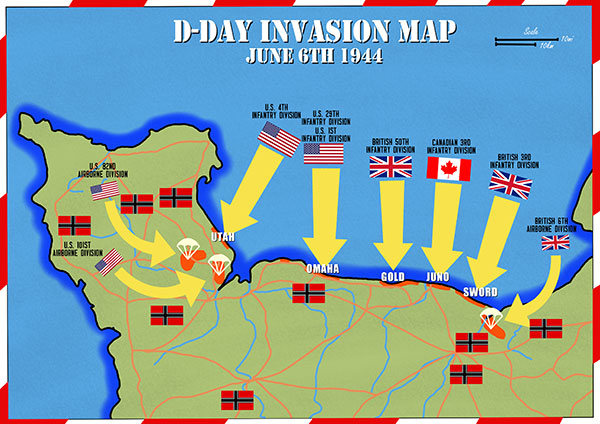
Once ashore the invading forces had to establish themselves separately on each of the 5 landing beaches. Code-named from the West, UTAH, OMAHA, GOLD, JUNO & SWORD.
They relied upon continual support by Air and Sea to provide reinforcement personnel in subsequent landings, equipment, ammunition, fuel, food etc.
Joining-up of the 5 separate beachheads and the subsequent breakouts, deeper into France could not be otherwise be achieved.
On the days and weeks leading up to and subsequent to D-Day, this part of the South coast at Lepe and Stanswood was, along with many other locations around the coast, an important base from which OPERATION NEPTUNE was to be launched and supported.